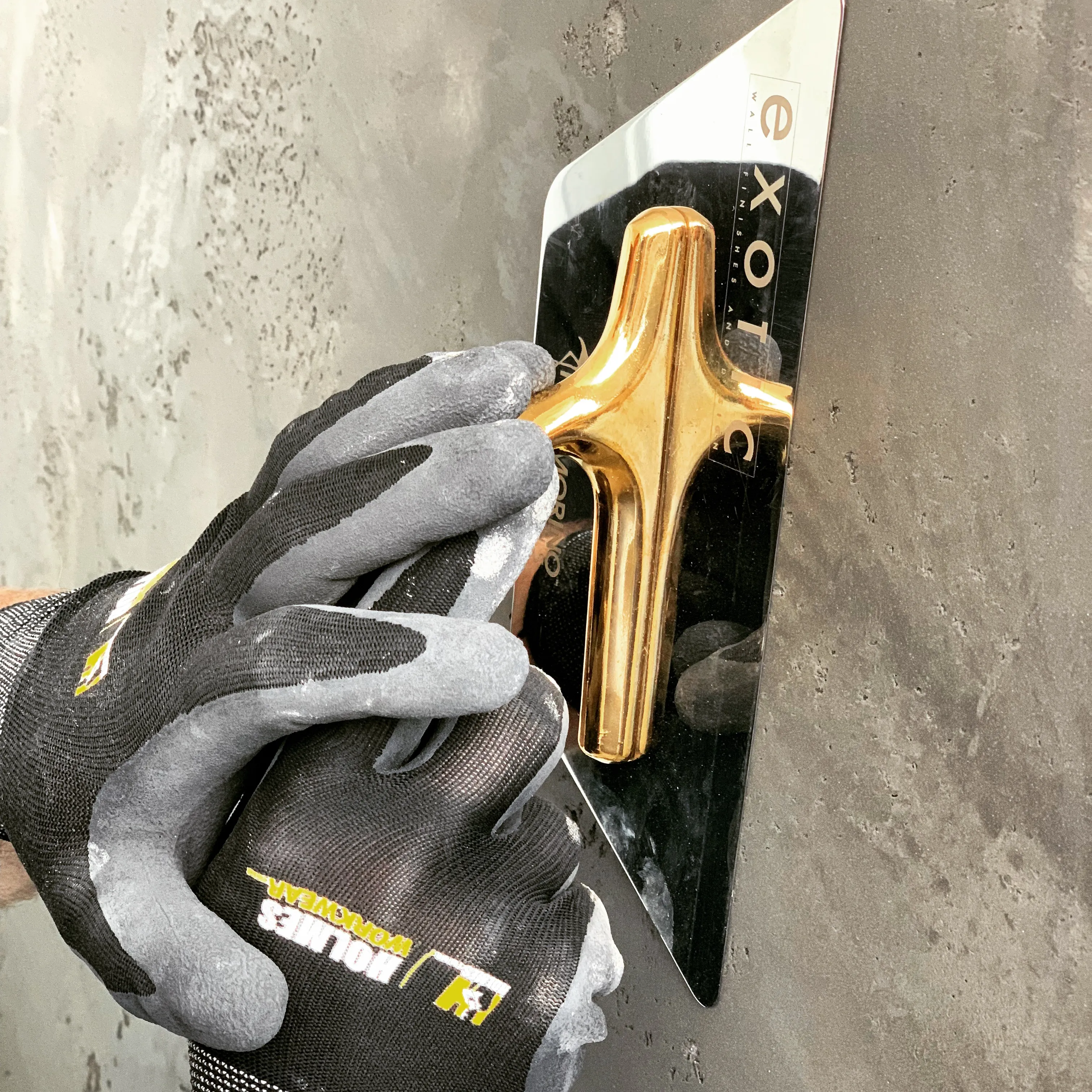
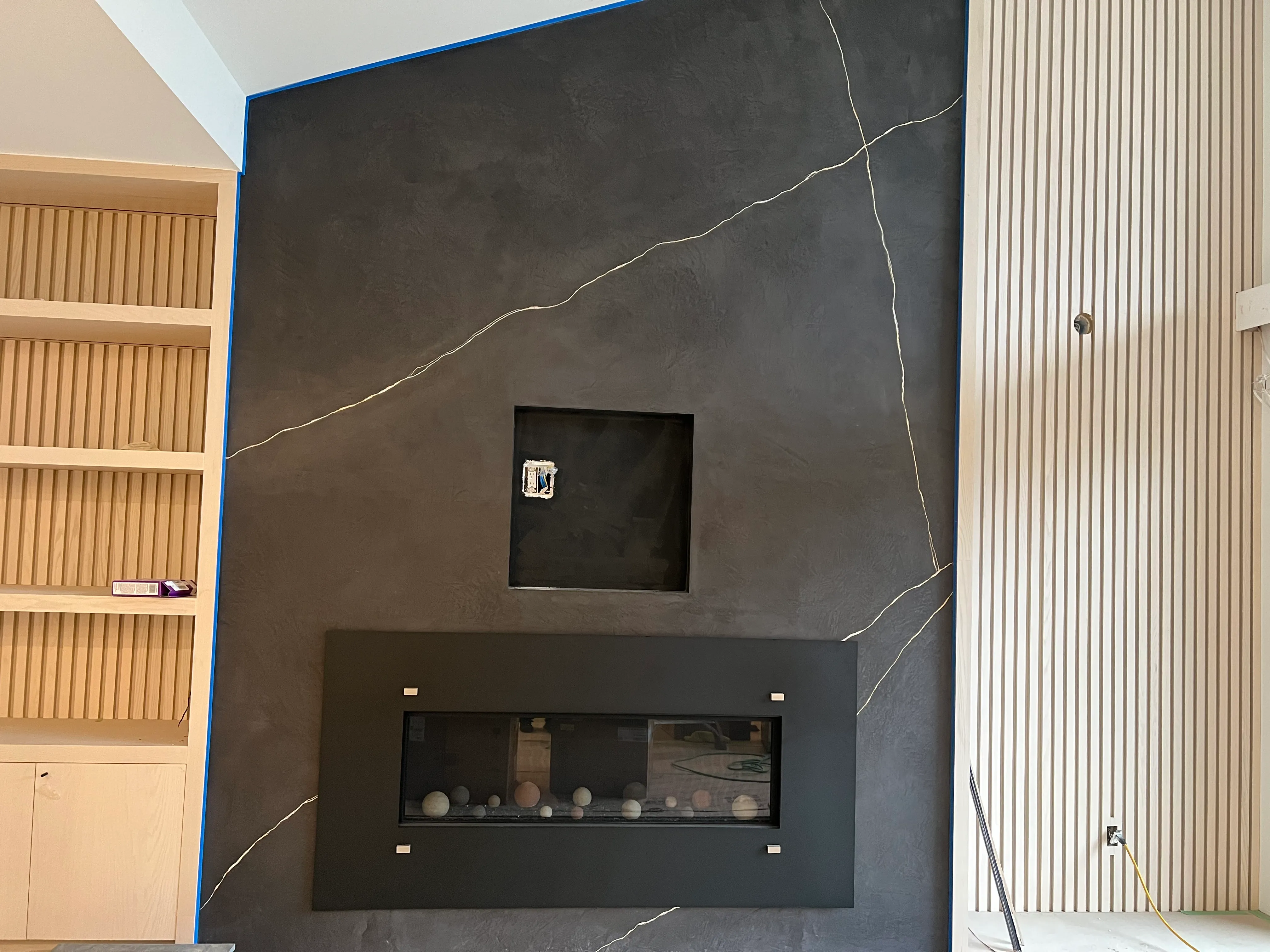
A seamless mineral surface applied by hand over a prepared substrate — continuous across walls, floors, ceilings, bathrooms, showers and wet areas, with no grout lines and no joints.
Microcement is a cement-based coating applied in successive thin layers over a prepared substrate, then sealed. Because it is troweled rather than laid, it runs continuously from floor to wall to shower bench without a joint, a grout line or a transition strip — which is what makes a small bathroom read as one volume rather than a collection of tiled planes.
It bonds over existing tile, concrete, plywood and drywall, so a bathroom can often be refinished without demolition. Total build-up is only two to three millimetres, so floor heights and door clearances usually stay as they are.
Applied by hand, it carries movement and tonal variation across the surface. That variation is a property of the material, not a defect — it is the reason microcement reads as a finish rather than a product.
Feature walls, full rooms, stair walls and hallways. Applied over drywall, plaster, concrete or existing tile.
Continuous floors across open-plan spaces, with no transitions between rooms. Requires a flat, sound substrate — which is why floor preparation comes first.
Ceiling application to carry the finish overhead, often paired with cove or linear lighting detailed into the perimeter.
Vanity walls, floors, bath surrounds and niches finished as one surface, with far less grout to maintain.
Shower enclosures, benches and curbs over a correctly detailed waterproofing membrane, sealed for wet-area use.
Retail interiors, hospitality spaces, reception areas and lobbies, and coordinated multi-unit residential work.
Microcement is largely a preparation trade. The finish coats are the visible part; the work that determines both cost and longevity happens underneath.
We do not publish square-foot pricing, because a number quoted without seeing the substrate is a guess. Every quote follows a site visit.
Yes, provided the waterproofing is detailed correctly first. Microcement is a finish, not a waterproofing layer — it is applied over a properly installed membrane and then sealed for wet-area use. Where that sequence is followed, showers, benches and curbs can be finished as one continuous surface.
In most cases, yes. Sound, well-bonded tile can be prepared and coated directly, which often avoids demolition entirely. Loose tile, movement in the substrate or failed grout must be addressed first — we assess this at the site visit before committing to an approach.
Microcement is cement-based, applied in thicker layers, and suited to floors and wet areas as well as walls. Venetian plaster is lime-based, polished to a much finer surface with visible depth, and used on walls and ceilings rather than floors. They are often specified together in the same project for exactly that reason.
Microcement moves with the substrate beneath it. A slab with active cracking or deflection will telegraph through any thin-coat finish, which is why substrate assessment and preparation are the first stage of every job rather than an optional extra.
Typical build-up is around two to three millimetres, so door clearances and floor heights usually remain unchanged — one of the reasons it suits renovations where a tiled floor would raise levels too far.
Grinding, patching and levelling the substrate so the finish has something flat and sound to bond to.
View serviceLime-based plasters and liquid metal, often specified on walls where microcement runs across the floor.
View serviceCove and linear details set out before finishing, so the light source stays concealed within the surface.
View serviceTables, benches, plinths and vanities finished in the same material as the surfaces around them.
View service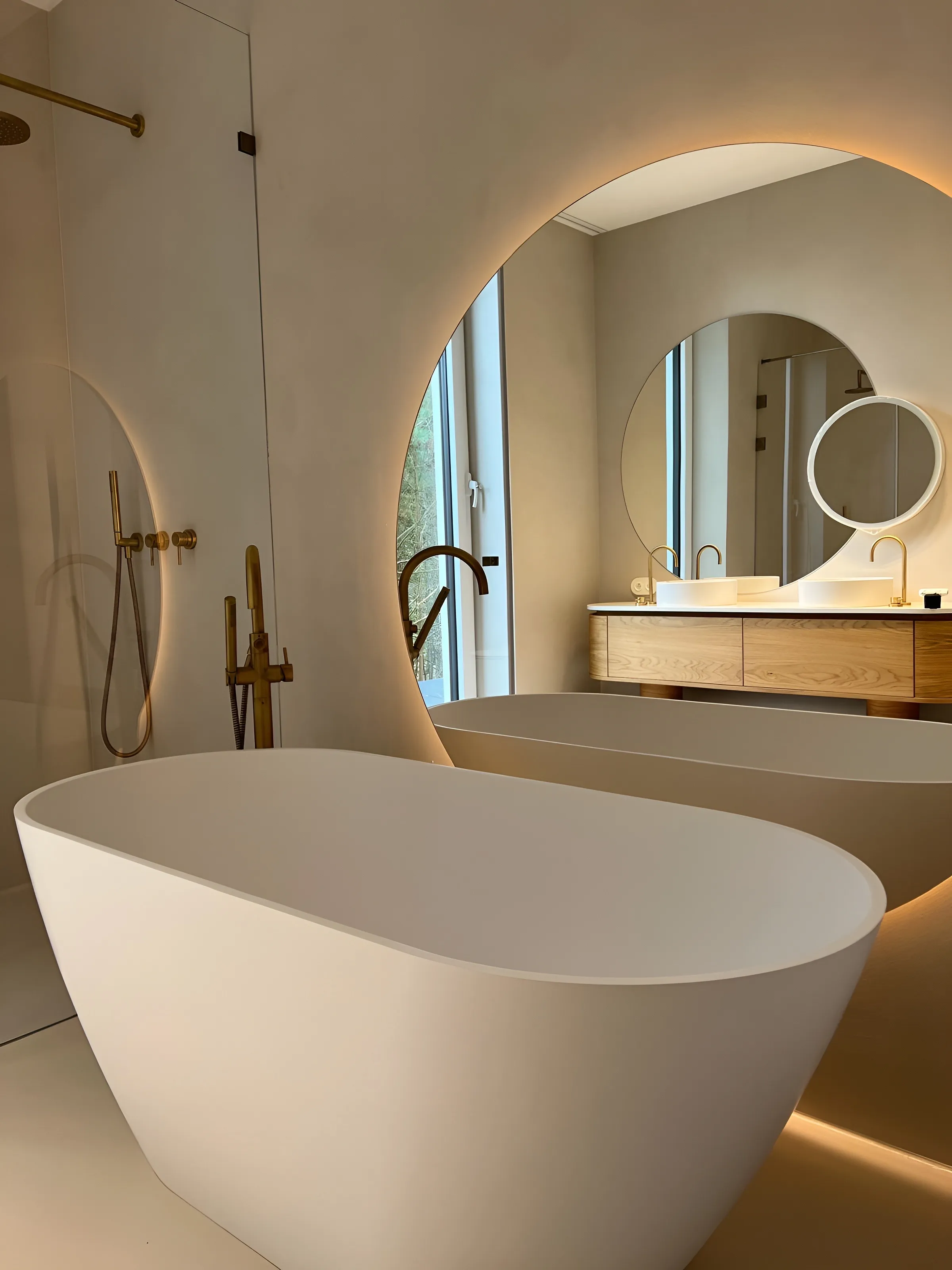
A microcement bathroom finished as a single continuous surface — no grout lines, no transition strips, no tiled planes meeting at a corner. The backlit mirror and brass fixtures read cleanly because there is nothing competing with them.
This is what the material does that tile cannot: it lets a small room read as one volume.
Discuss a microcement bathroomMicrocement systems we install — manufacturer details to be added.
Every microcement quote follows a site visit, because the surface underneath decides both the price and how long the finish lasts. We work across Vancouver, Burnaby, North Vancouver, West Vancouver and the wider Metro Vancouver area.