
Venetian Plaster vs. Microcement: Which Finish Is Right for Your Interior?
They are often discussed as alternatives, but they belong to different families and solve different problems. A practical comparison for walls, floors and wet areas.
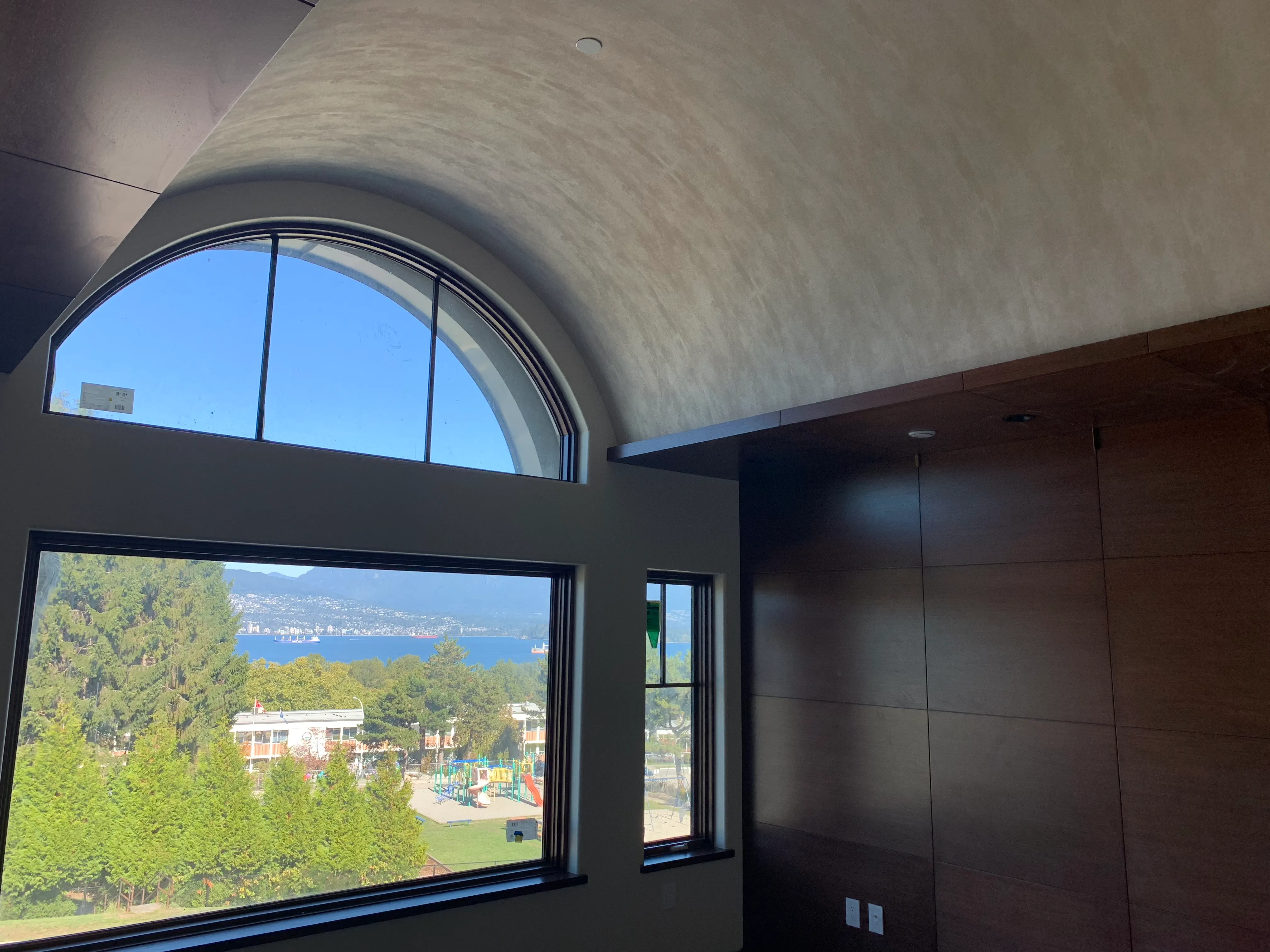
Short answer: choose Venetian plaster when you want a decorative wall or ceiling finish with depth, movement and a polished, stone-like character. Choose microcement when you want a continuous architectural surface that can also run across floors, into showers and around joinery.
They are frequently presented as competing products. They are not. Microcement belongs to architectural surfaces — a cement-based system built up over a prepared substrate. Venetian plaster and polished plaster belong to decorative finishes — lime-based finishes worked and burnished by hand. Treating them as interchangeable is how a finish ends up in the wrong room.
Visual appearance
Venetian plaster reads as depth. Worked in thin layers and burnished, it develops a translucent quality with movement and subtle variation across the wall, closer in character to polished stone than to paint. It changes noticeably as the light in a room moves across it during the day.
Microcement reads as continuity. It gives a quieter, more uniform mineral surface with a fine texture and gentle cloudiness, and the visual impact comes from the absence of joints — a wall that runs into a floor, a shower with no grout lines, a bath surround with no visible edge.
Texture and sheen
Venetian plaster ranges from a matte, softly textured Marmorino through to a highly burnished polished plaster with a marble-like sheen. The sheen is produced by the work, not by a topcoat.
Microcement is generally matte to satin, with the final appearance set by the trowel work and confirmed by the sealer specified. A sealer can shift the sheen, but microcement does not reach the mirror-like polish of a fully burnished plaster.
Suitable surfaces
Venetian plaster is a wall and ceiling finish. It suits feature walls, hallways, entries, dining rooms, powder rooms and ceilings. It is not a floor finish.
Microcement works on walls and floors, and across joinery, counters, stairs, benches and niches. That range is precisely why it is chosen for whole-room schemes.
Bathrooms and wet areas
This is the clearest dividing line. Microcement, over a correctly built and waterproofed assembly, is used inside showers and on bathroom floors. Venetian plaster is generally kept away from direct and repeated water — it is well suited to a powder room or a bathroom wall away from the shower, but it is not the finish for a shower enclosure.
In both cases the same rule applies: the finish is not the waterproofing. Our article on microcement in bathrooms and showers sets out what has to sit beneath it.
Floors versus walls
If a floor is part of the scheme, microcement is the answer. If the project is a single striking wall, or a room where the walls should feel hand-worked and alive, Venetian plaster will do something microcement cannot.
Substrate preparation
Both are thin, hand-applied finishes, and both follow the surface beneath them. Neither corrects a substrate that moves, and neither is a way to avoid making a wall flat. Microcement, because it also goes on floors and in wet areas, brings the additional questions of deflection, waterproofing and junction detailing. Venetian plaster is usually applied over a well-prepared, sound plastered or boarded wall.
Durability
Microcement is the more robust of the two in use, which is why it is specified for floors, wet areas and commercial interiors. It will still show wear where traffic is heaviest.
Venetian plaster is durable on a wall in normal use, but it is a decorative finish. In a busy corridor, a commercial entrance or a household with active children and pets, its position matters — a feature wall in a dining room behaves very differently from a wall along a main circulation route.
Maintenance
Microcement depends on its sealer: clean with a mild, pH-neutral product, avoid abrasives and harsh chemicals, and expect the sealer to be maintained over time, particularly on floors.
Venetian plaster is usually maintained more simply — dusting and gentle cleaning. Some finishes are waxed or protected, in which case the protection is maintained rather than the plaster itself.
Repair considerations
Neither finish is repaired like tile, where a damaged unit is swapped. Both are blended by a skilled applicator, and both benefit from being repaired by whoever applied them originally, or at least by someone working with the same system. In practice, Venetian plaster repairs on a defined feature wall are often more straightforward than repairs to a continuous microcement floor, because the wall has natural boundaries.
Residential applications
In homes, Venetian plaster tends to appear where the design wants a moment: an entry, a fireplace wall, a dining room, a powder room. Microcement tends to appear where the design wants calm continuity: a bathroom, an open living level, a stair, a kitchen island.
Commercial applications
In retail and hospitality, Venetian plaster is used for atmosphere on feature surfaces, while microcement handles floors and the surfaces that take contact and cleaning. Both benefit from an early, honest conversation about traffic and the cleaning regime, because those decide the specification more than the mood board does.
Comparison at a glance
| Venetian plaster | Microcement | |
|---|---|---|
| Family | Decorative Finishes | Architectural Surfaces |
| Base | Lime-based | Cement-based |
| Character | Depth, movement, polish | Continuous, mineral, seamless |
| Walls | Yes | Yes |
| Floors | No | Yes |
| Showers and wet floors | Not recommended | Yes, over a waterproofed assembly |
| Typical sheen | Matte to high polish | Matte to satin |
| Maintenance | Gentle cleaning; protection refreshed if used | Sealer-dependent; maintained over time |
| Repairs | Blended by an applicator | Blended and re-sealed by an applicator |
When Venetian plaster is the better choice
- The project is a wall or ceiling rather than a whole room.
- You want visible depth, movement and a hand-worked character.
- The surface is away from direct, repeated water.
- The room is about atmosphere rather than traffic.
When microcement is the better choice
- Floors are part of the scheme.
- The space is a bathroom, shower or wet room.
- You want a continuous surface across walls, floors and joinery.
- The surface will take real use and regular cleaning.
Frequently asked questions
Are Venetian plaster and polished plaster the same thing?
They belong to the same family. Polished plaster generally refers to a more highly burnished result with a stronger sheen, while Marmorino sits at the more matte, textured end of the range. Both are decorative lime finishes, distinct from microcement.
Can both be used in the same project?
Often that is the strongest outcome — microcement carrying the bathroom or the floor plane, Venetian plaster taking one considered feature surface elsewhere.
Which is more expensive?
Neither has a fixed answer. Cost follows the substrate condition, the preparation required, the area, the number of junctions and the finish specified. A site visit gives a realistic figure; a rate per square metre rarely does.
Can either be applied over existing walls?
Frequently yes, once the existing surface has been assessed and prepared. Sound, flat and stable is what matters.
Do samples show exactly what I will get?
They show the intended direction and range. Both are hand-applied, so the finished surface carries natural variation — that variation is the point of the material.
Related pages
See Venetian Plaster & Decorative Finishes, Polished Plaster and Microcement & Architectural Surfaces, or browse Surfaces & Finishes projects.
If you are weighing the two for a specific room, request a consultation — the substrate and the use usually settle the question quickly.
Planning work like this?
Send us the space, the substrate and the finish you have in mind. We will tell you what is realistic before anything is ordered or installed.