
Stairs & Stair Nosings
Stair renovation, custom treads and risers, flush nosings and floor transitions — the detail that decides whether a staircase looks designed or merely covered.
Why Stairs Reveal the Quality of a Renovation
A staircase is seen from above, below and at eye level, often in the brightest part of the house. Every inconsistency in a tread edge, every gap at a riser, every mismatched nosing profile is visible from somewhere.
It is also the one element that has to physically resolve into the floor on two different levels. Getting that junction right is why stair work belongs with the flooring scope rather than being handed to a separate trade at the end.
What We Do
Stair Renovation
Refinishing or recladding an existing staircase — usually replacing carpeted treads with timber, or bringing a dated staircase in line with new flooring.
Custom Treads & Risers
Treads cut and finished to match the floor, with risers in matching timber, painted, or left open depending on the design intent.
Flush Stair Nosings
A nosing that sits level with the tread rather than as a raised metal strip — a cleaner line, and no lip to catch underfoot.
Floor Transitions
Where the staircase meets flooring at the top and bottom, detailed so grain, colour and level read as continuous.
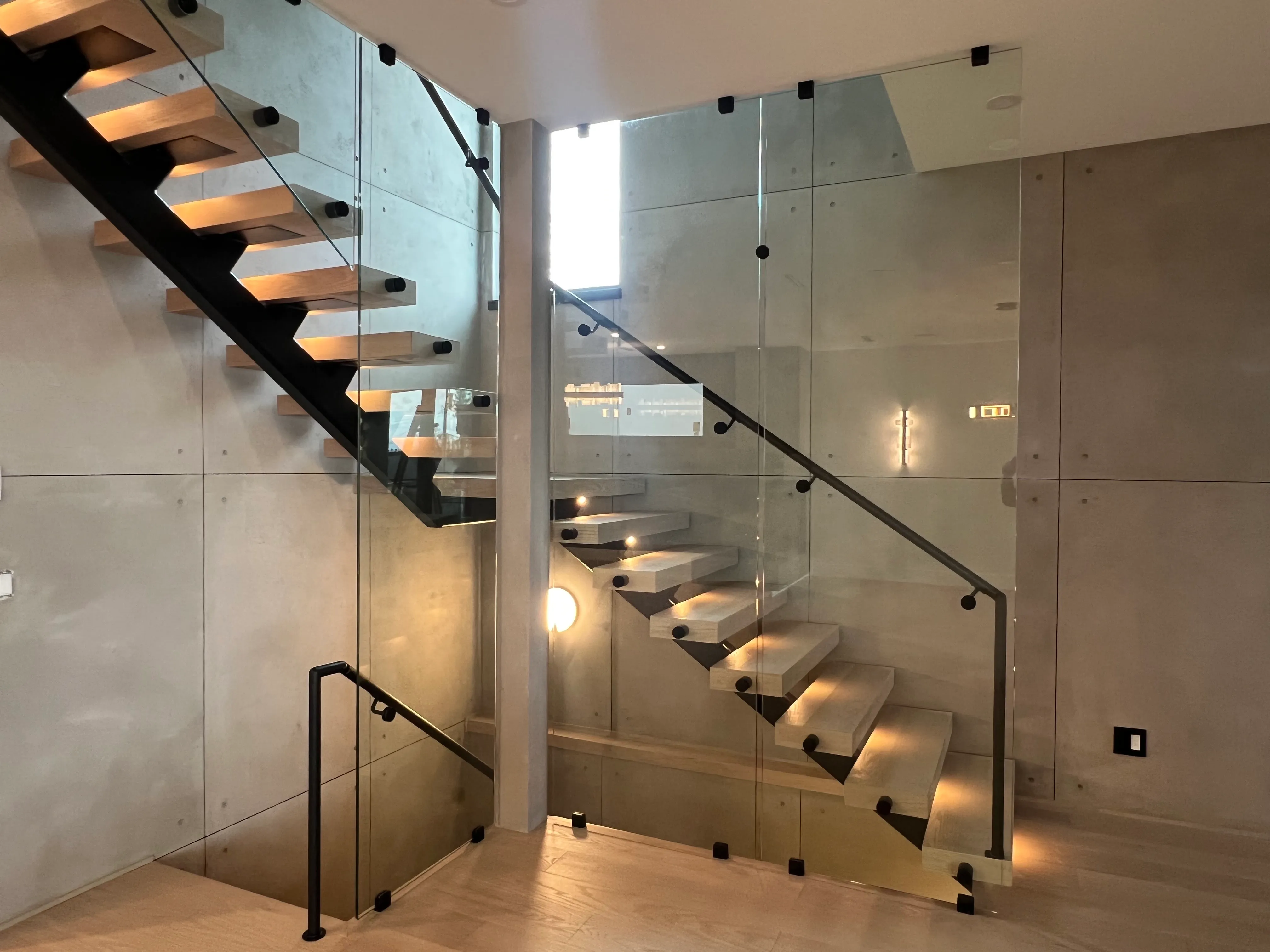
Floating Steps
Cantilevered treads finished to a fine tolerance. Structural support is designed and certified by others; we handle the finish and detailing.
Stair Lighting Details
Recesses and channels for concealed LED lighting formed during construction, with connection by licensed electrical professionals.
What We Do Not Do
We are a finishing trade, not a structural engineer. Changing a staircase's rise, run, load path or opening requires structural design and permitting by qualified professionals. We work within an approved structure and take responsibility for how it is finished.
How a Stair Renovation Runs
Measure Every Step
Older staircases are rarely uniform. Each tread is measured individually rather than assuming a single dimension across the flight.
Strip & Assess
Carpet and existing coverings come off so the substrate can be checked for squeaks, movement and damage before new material is committed.
Fabricate to Fit
Treads, risers and nosings are cut to each individual step and dry-fitted before final fixing and finishing.
Finish & Protect
Finishing is scheduled around access, since a staircase usually cannot be closed off for long, and treads are protected while other trades work.
Stair Questions
Can carpeted stairs be converted to timber?
Usually yes. Carpeted stairs often have rough construction-grade treads underneath, so the normal approach is to clad or replace them rather than sand what is there.
What is a flush nosing and why choose it?
A flush nosing finishes level with the tread instead of sitting proud as a metal strip. It gives a cleaner edge line and removes a raised lip, which matters visually and underfoot.
Can we use the stairs during the work?
Generally yes, with restrictions while adhesives and finishes cure. We sequence flights so there is safe access, and we will tell you which periods are genuinely off limits.
Will the stairs match our new floor exactly?
That is the aim, and it is most achievable when stairs and flooring are specified together from the same batch. Matching to an already-installed floor is possible but harder.
Discuss Your Staircase
Tell us the staircase, its current condition and the flooring it needs to meet. We will advise on approach and quote in writing.