
Star Ceilings in Vancouver
Fibre-optic starlight built into a stretch membrane or plasterboard ceiling — hundreds of individual points of light with no bulb at the ceiling, no heat and no visible fixture. Installed in homes, theatres and hospitality interiors across Metro Vancouver.
What a Star Ceiling Actually Is
A star ceiling is not a printed image or a projection. Individual fibre-optic strands are threaded through the ceiling plane so that each one finishes flush with the surface. A single remote light source — the illuminator — feeds the whole harness, and the light travels down the fibres to their tips.
Because the source sits away from the ceiling, nothing at the surface generates heat or carries current. When the lamp inside the illuminator reaches end of life, one unit is serviced instead of hundreds of points, and the ceiling itself is never opened.
What separates a convincing sky from a decorative pattern is distribution. Mixed fibre diameters give the field depth, irregular spacing stops the eye reading a grid, and density is varied deliberately so parts of the ceiling stay dark. We agree that distribution on a drawing before a single strand is pulled.
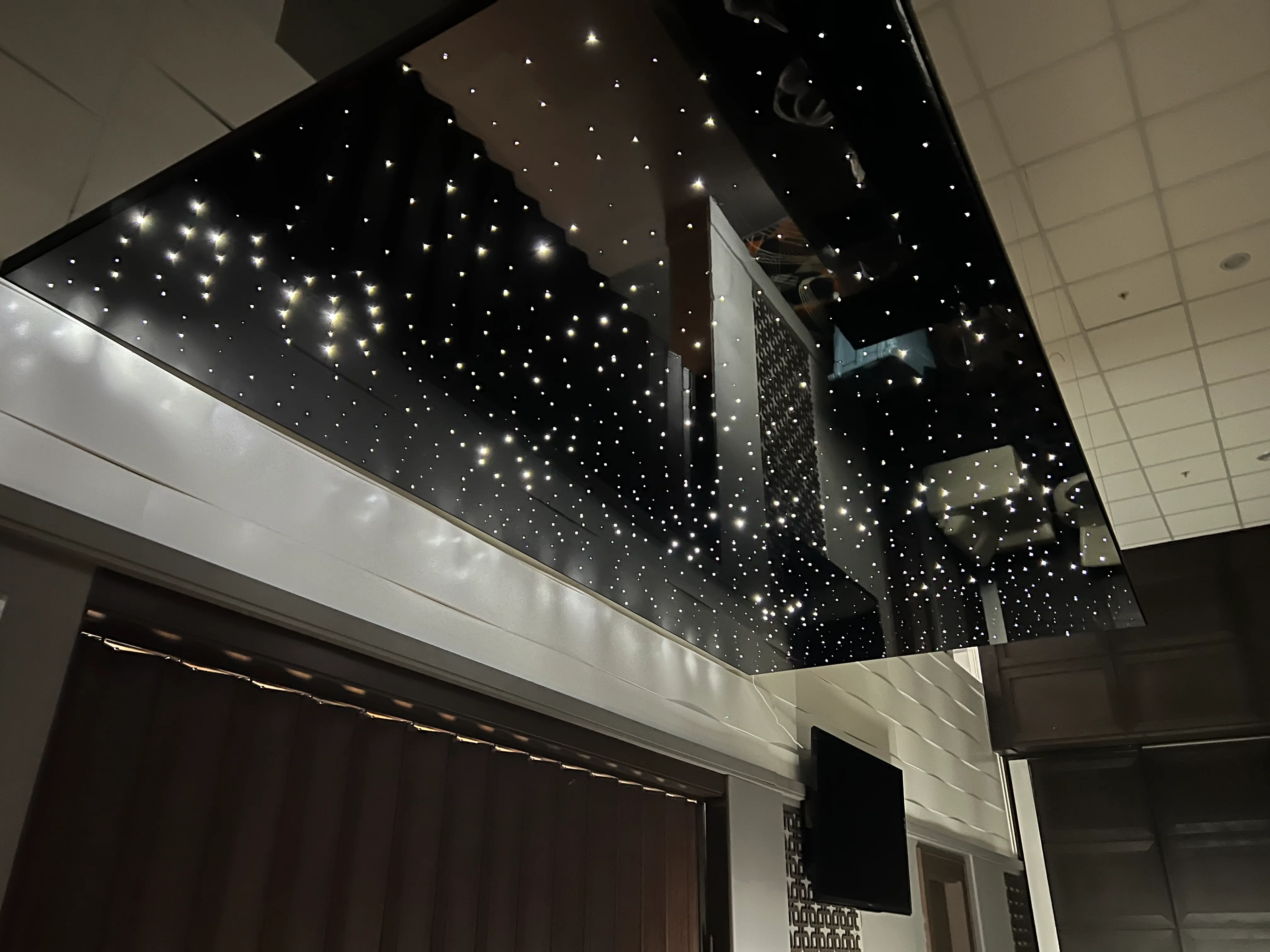
A field with depth, not a grid.
Fibres of different diameters set at irregular spacing across a gloss black membrane. Brighter points sit forward, finer ones fall back, and the gloss surface doubles the field in reflection — which is why the ceiling reads as depth rather than as dots on a plane.
The density here is deliberately uneven. An evenly spaced ceiling reads as a product; an uneven one reads as a sky.
Discuss a star ceilingHow the Sky Is Specified
Membrane or Plasterboard
Fibres can be set into a tensioned stretch membrane or through a plasterboard ceiling. A membrane keeps the harness accessible and gives a gloss or matte black field; plasterboard suits rooms where the ceiling is already being built new.
See stretch ceiling finishesTwinkle, Colour and Shooting Stars
A twinkle wheel inside the illuminator makes points fade in and out at random. Colour-changing sources shift the whole field, and separate shooting-star fibres can be run for an occasional streak across the ceiling.
Explore custom lightingMapped Constellations
A field can follow a real star chart rather than a random scatter — a particular hemisphere, a specific date, or a constellation placed where it will be seen from the bed or the seating position.
See backlit ceilingsRooms That Suit a Star Ceiling
The effect depends on darkness, so it belongs in rooms that can be darkened: home theatres and media rooms, primary and children’s bedrooms, spas and wet rooms where a warm low light is wanted, and hospitality interiors where the ceiling is part of the atmosphere rather than just a surface.
It also solves a problem that lighting alone cannot. In a windowless basement theatre or an interior spa, a star field gives the room a sense of height and open sky where there is neither.
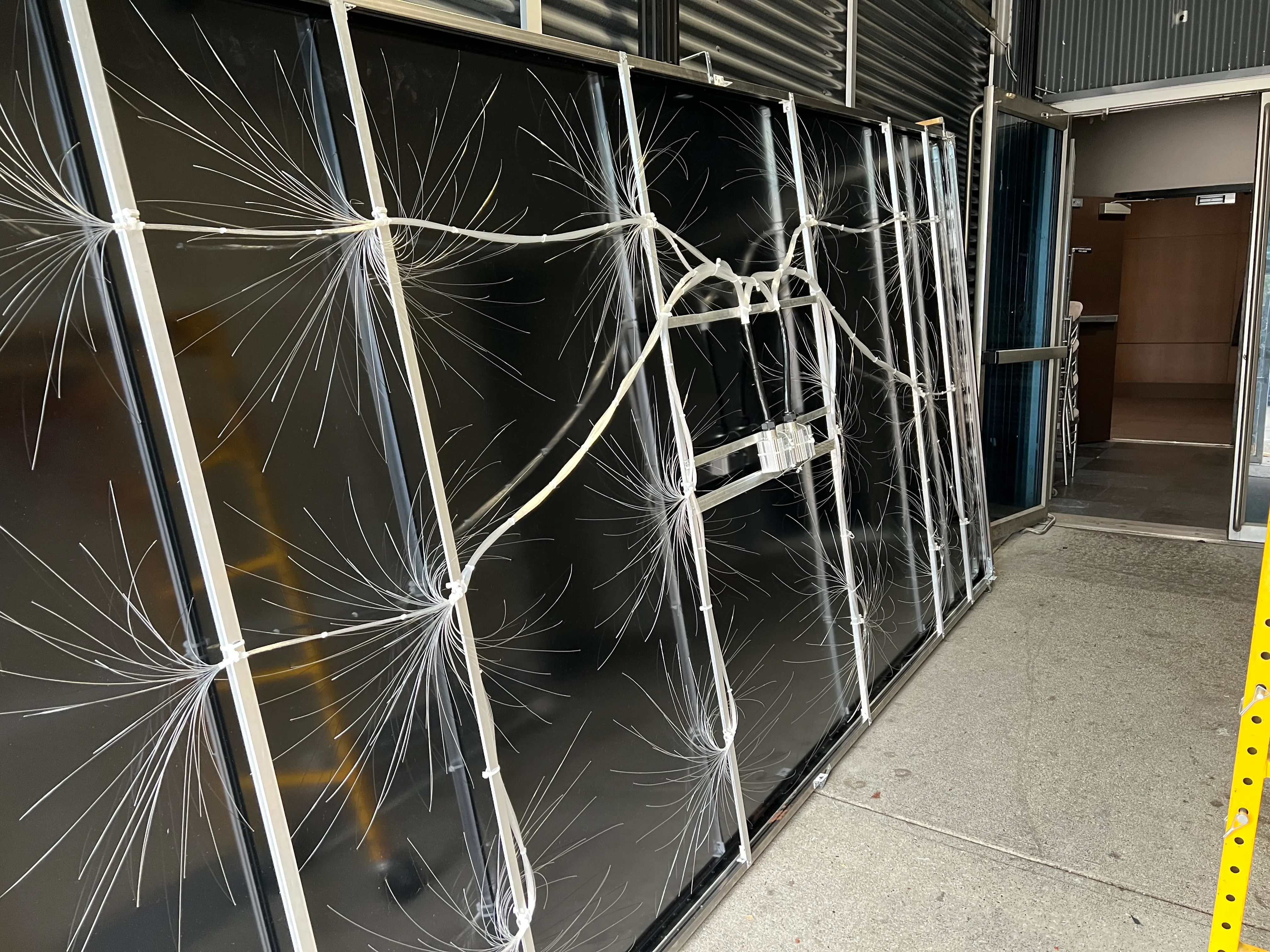
The harness is built first.
Fibre bundles fan out from their feed point across the panels and are set to the agreed pattern before anything is delivered to site. Every strand is cut, threaded and trimmed flush while the panel is still flat and reachable.
Doing this off site is what keeps the installation itself short and clean — the ceiling arrives already carrying its sky, and the work in the room is fixing, tensioning and connecting.
Ask about lead timesFour Things Decided Before Fabrication
Density and pattern
How many points, at what spread, and whether the field is random, graded or mapped to a real star chart. This is drawn and agreed rather than improvised at the ceiling.
Illuminator location
The light source needs a ventilated, reachable position within the run length of the fibre — typically a nearby closet, bulkhead or service void, agreed before first fix.
Substrate
Stretch membrane or plasterboard, and in which colour and sheen. A gloss black membrane deepens the field by reflection; matte keeps it quiet.
Effects and control
Twinkle, colour change and shooting stars each need their own provision at the illuminator, along with a control method chosen before wiring rather than after.
Star Ceilings, Answered Plainly
Do the fibres need replacing or maintaining?
No. The fibres carry light rather than current, so they do not wear out, heat up or burn out. The only serviceable part is the illuminator, which sits away from the ceiling in an accessible position agreed during planning.
How much ceiling height does it take?
A membrane star ceiling needs the same drop as any stretch ceiling plus room for the harness to run above it. In a plasterboard ceiling the fibres sit within the existing void. We measure the room and confirm the figure before committing to a substrate.
Can it be installed in an existing room?
Usually yes. A stretch membrane fixes to a perimeter track rather than to the ceiling above, which makes retrofit straightforward. What has to be found is a route for the fibre and a home for the illuminator — that is the part worth checking early.
Is it safe above a bathtub, steam room or pool?
The ceiling points themselves carry no electricity and produce no heat, which is one reason the system suits wet areas. The illuminator is placed in a dry, ventilated location, and its connection is carried out by licensed electrical professionals.
Can the stars be arranged as a real night sky?
Yes. A field can follow an actual star chart for a chosen hemisphere or date, with constellations positioned so they sit in view from the bed or the seating position rather than in a corner of the room.
Where do you install star ceilings?
Across Metro Vancouver, including Vancouver, Burnaby, Richmond, Surrey, North Vancouver, West Vancouver, Coquitlam, Port Moody, New Westminster, Delta, Langley and White Rock.
Specified Alongside
Stretch Ceilings
Matte, satin, gloss and printed membranes tensioned to a clean perimeter detail across a whole room.
Explore stretch ceilingsBacklit Stretch Ceilings
Translucent membranes lit evenly from behind, with recessed light lines and perimeter cove detailing.
Explore backlit ceilingsCustom & Linear Lighting
Linear runs, cove details and integrated architectural lighting detailed into the construction.
Explore custom lighting
Discuss a Star Ceiling
Tell us the room, how dark it gets and whether the ceiling is existing or being built new. We will advise on density, substrate, where the illuminator can live and how the work sits in your programme.