
Backlit Stretch Ceilings in Vancouver
A translucent membrane lit evenly from behind, so the light becomes the ceiling rather than something mounted on it. Installed across Metro Vancouver in homes, condominiums, retail and hospitality interiors.
How a Backlit Ceiling Is Built
A backlit ceiling is a shallow light box with a tensioned membrane as its face. LED strips or panels are mounted in a cavity above, the cavity is finished so it reflects rather than absorbs, and a translucent membrane is stretched across a perimeter track below. The membrane conceals every fixture, so what you see is an even plane of light with no visible source.
The controlling variable is cavity depth. Too shallow and individual diodes read through the membrane as hot spots; deep enough and the output merges into a continuous field. We set strip spacing against the available depth before anything is ordered, because that decision cannot be corrected once the ceiling is closed.
Wiring routes, driver positions and control method are agreed with the electrical scope while the ceiling is still open, so drivers stay reachable afterwards. Final connection and certification are carried out by licensed electrical professionals. We detail and install the architectural element that the lighting sits within.
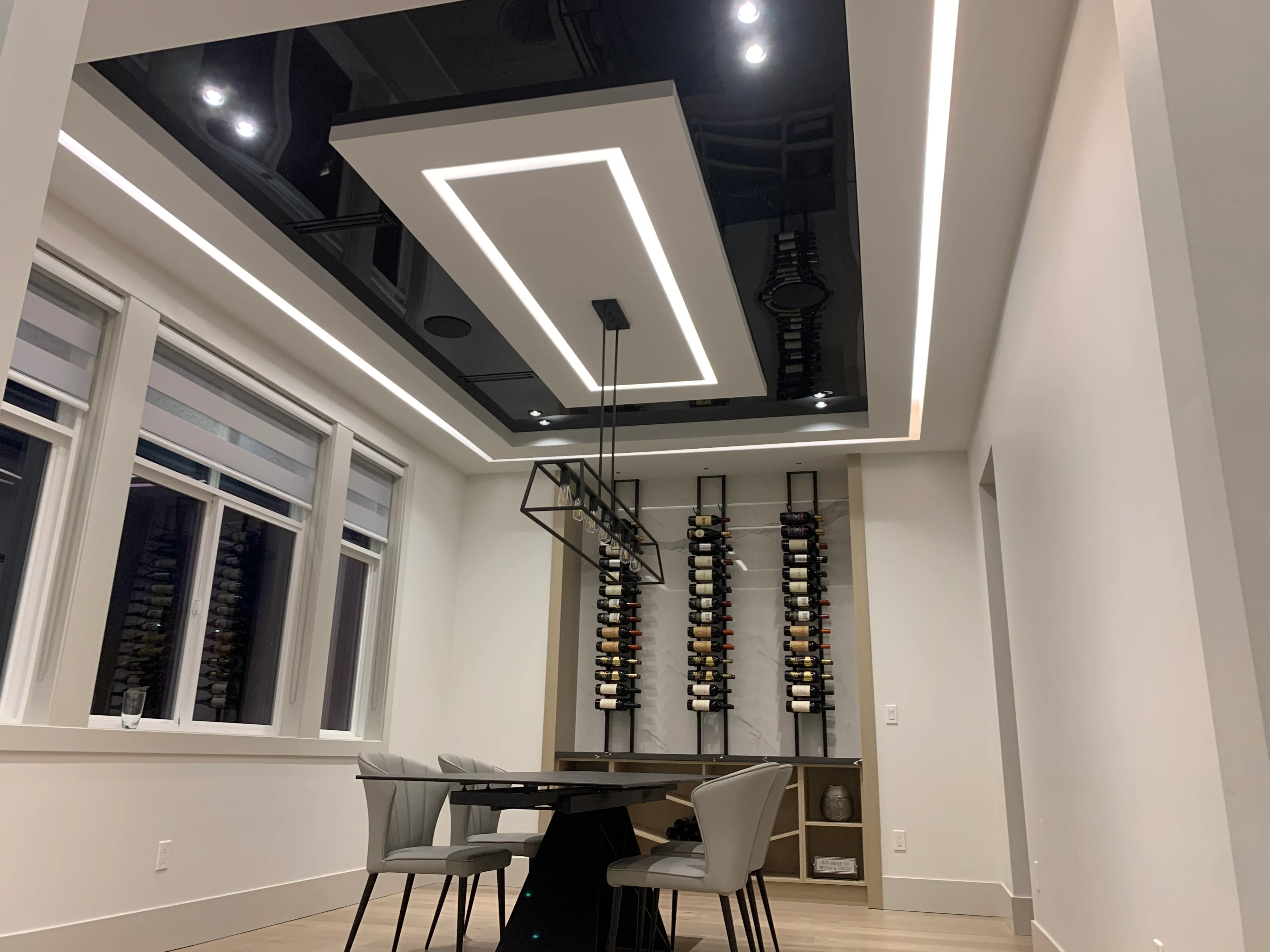
Light set into the ceiling, not onto it.
A gloss membrane coffer with a recessed linear run inside it and a soft perimeter glow at the edge. There is no downlight aimed at the table and no pendant fighting the ceiling for attention — the ceiling itself is doing the work.
The recess, the track line and the cove were set out before the membrane was ordered, which is the only point at which those positions can still be moved.
Discuss a backlit ceilingWays to Light a Membrane
Translucent Luminous Panels
A full field of even light behind a translucent membrane, framed by the surrounding ceiling. Used where a room needs a calm, sourceless brightness rather than a pattern of fixtures — kitchens, bathrooms, spas and interior rooms with no window.
See stretch ceiling finishesRecessed Linear Light Lines
Narrow illuminated lines set flush into the membrane, following the geometry of the room or cutting deliberately against it. The line reads as a clean edge of light because the fixture body sits above the finished plane.
Explore custom lightingPerimeter Cove Glow
Indirect light released at the junction between ceiling and wall, so the ceiling appears to float. Effective in condominiums where the slab is low and a bright central fixture would make the room feel shorter.
See star ceilingsWhere Backlit Ceilings Earn Their Place
They work hardest in rooms that cannot be fixed by adding more fixtures: interior rooms with no daylight, condominiums where the slab cannot be cut, wet areas where painted drywall keeps failing, and spaces where the client wants light without seeing where it comes from. Because installation happens after the dusty trades finish, it usually falls near the end of a renovation programme.
They are also a practical answer to a bad ceiling. A backlit membrane conceals uneven concrete, ductwork and old repairs in a single plane, without levelling, taping or a repainting cycle.
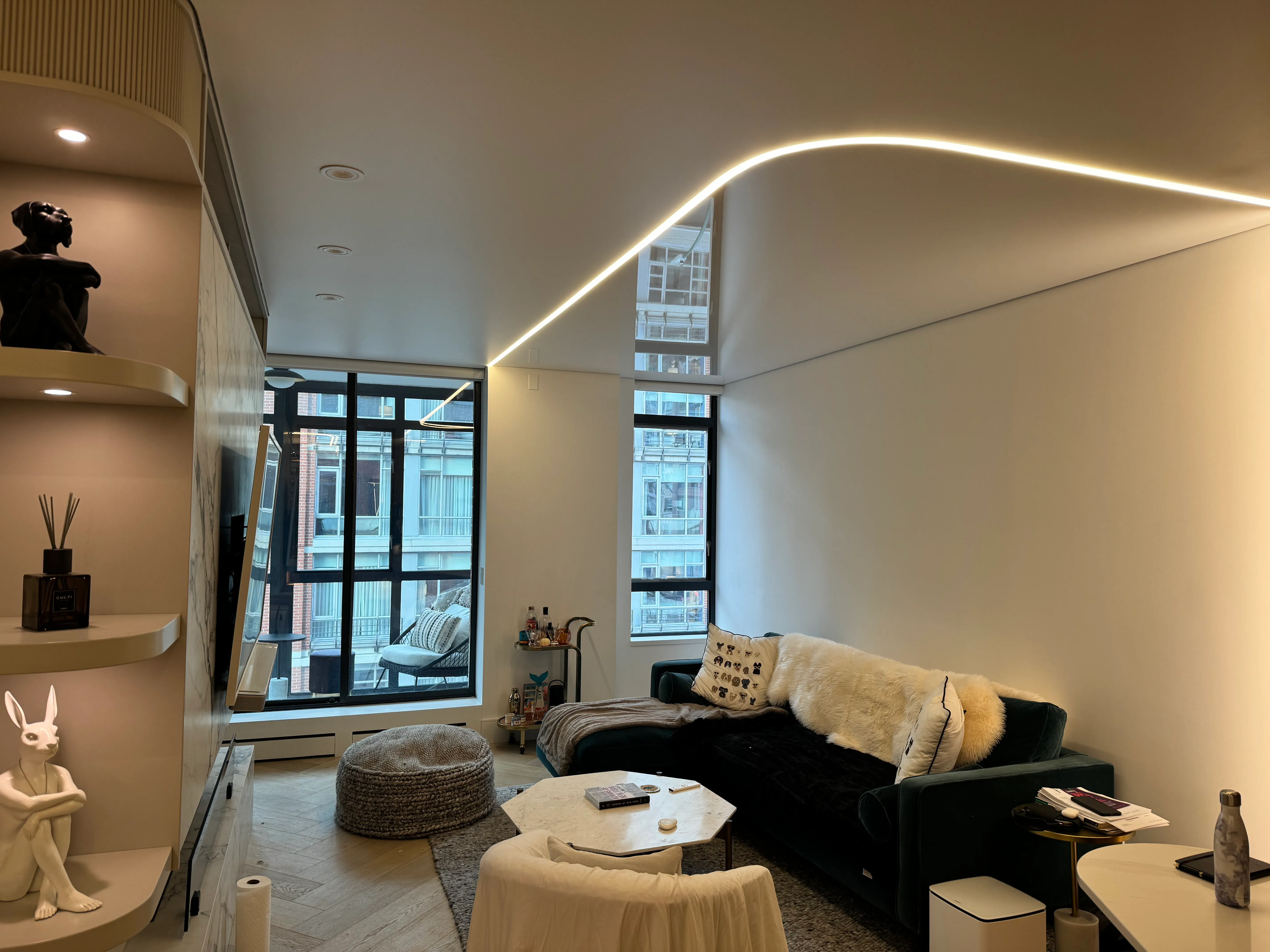
A single line, carried across the room.
A satin membrane with one concealed run curving across it. The line is continuous because the membrane is a single sheet — there is no joint for it to cross and nothing to align it against.
In a condominium with a low slab, a detail like this gives the room its light without dropping a bulkhead or losing usable height.
Explore custom lightingFour Decisions Made Before Anything Is Ordered
Cavity depth
We measure from the slab or joists to the intended finished plane and confirm there is enough depth for the light to diffuse. If the depth is not there, we say so rather than delivering a hot-spotted ceiling.
Electrical coordination
Circuit count, driver locations and switching are agreed with the electrical trade while the ceiling is open. Connection and certification are carried out by licensed electrical professionals.
Access and service
Drivers are positioned so they can be reached later without dismantling the ceiling. The membrane itself can be released and re-tensioned if access above is ever required.
Dimming and control
Dimmable, tunable-white and colour-changing systems each demand different wiring. The control method has to be settled before first fix, not chosen at handover.
Backlit Ceilings, Answered Plainly
How much ceiling height does a backlit ceiling take?
More than a plain stretch ceiling, because the light needs room to diffuse before it reaches the membrane. The exact drop depends on strip spacing, output and the membrane chosen, so we measure the room and confirm the figure before ordering. In condominiums with low slabs we will tell you honestly if the depth is not available.
Will the individual LEDs show through the membrane?
Not when cavity depth, strip spacing and membrane translucency are matched to each other. Hot-spotting is a design error rather than a limitation of the material, and it is the first thing resolved on site.
Can a backlit ceiling be dimmed or change colour temperature?
Yes. Dimmable drivers, tunable-white and colour-changing systems can all be specified. The choice has to be made before wiring, because it determines circuit count, driver size and where those drivers can sit.
Do you carry out the electrical work?
We detail and install the ceiling system — the cavity, the diffusion, the track and the membrane — and we coordinate closely with the electrical trade throughout. Final connection and certification are carried out by licensed electrical professionals. We do not present ourselves as an electrical contractor.
What happens if a driver fails after the ceiling is closed?
Drivers are placed so they can be reached without dismantling the installation, and a membrane section can be released and re-tensioned if access above is needed. This is planned during installation rather than improvised after a failure.
Where do you install backlit ceilings?
Across Metro Vancouver, including Vancouver, Burnaby, Richmond, Surrey, North Vancouver, West Vancouver, Coquitlam, Port Moody, New Westminster, Delta, Langley and White Rock.
Specified Alongside
Stretch Ceilings
Matte, satin, gloss and printed membranes tensioned to a clean perimeter detail, with or without integrated light.
Explore stretch ceilingsStar Ceilings
Fibre-optic starlight fields for home theatres, bedrooms and spas, built into membrane or plasterboard.
Explore star ceilingsCustom & Linear Lighting
Linear runs, cove details and backlit features detailed into walls and ceilings during construction.
Explore custom lighting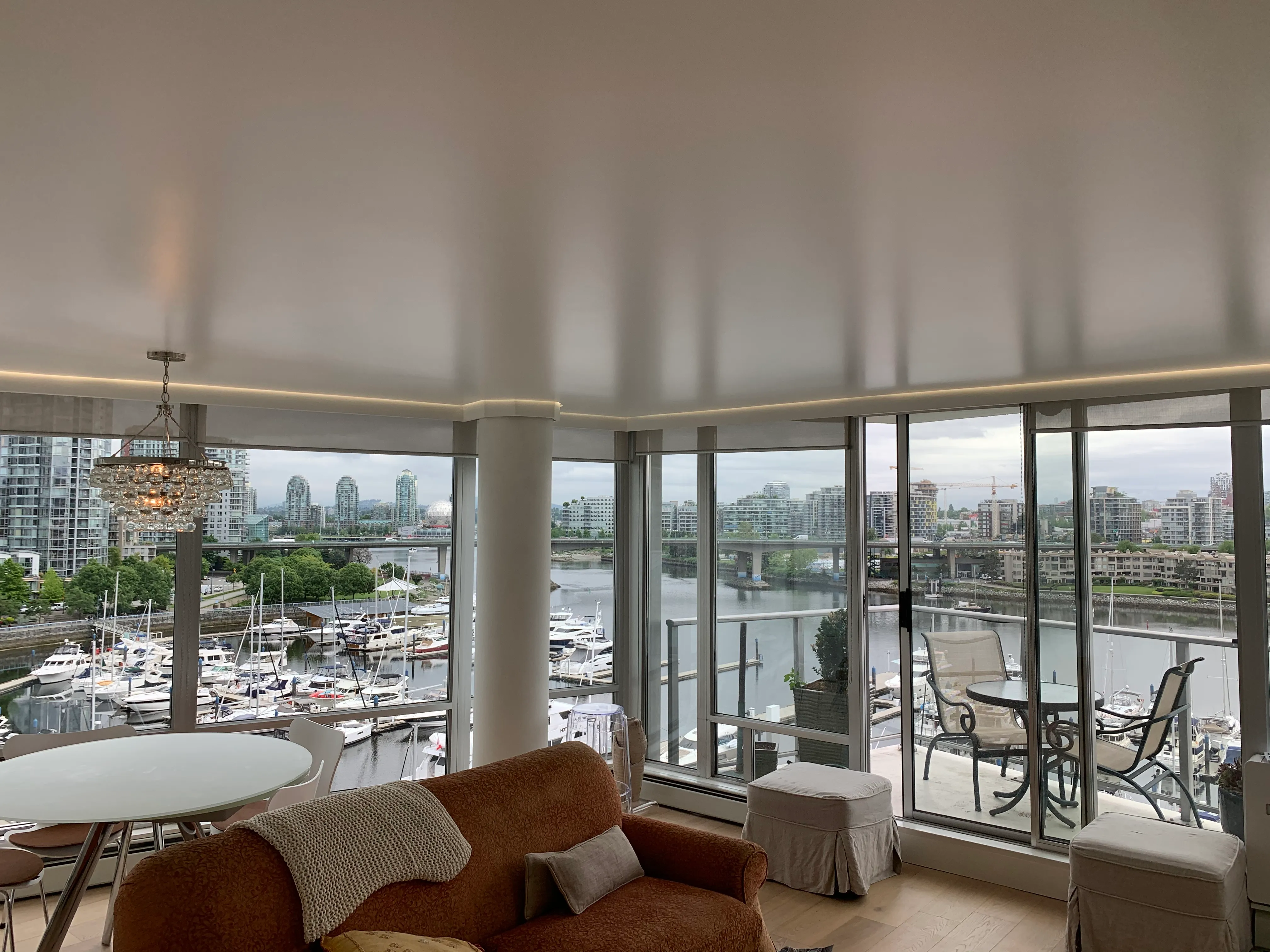
Discuss a Backlit Ceiling
Tell us the room, the available depth above the ceiling and whether the lighting is already specified. We will advise on diffusion, height loss, control options and where the work sits in your programme.