
Stretch Ceilings in Vancouver: Types and Installation Considerations
How a stretch ceiling system works, the finishes available, what has to happen above it, and the factors that genuinely move the cost of a project.
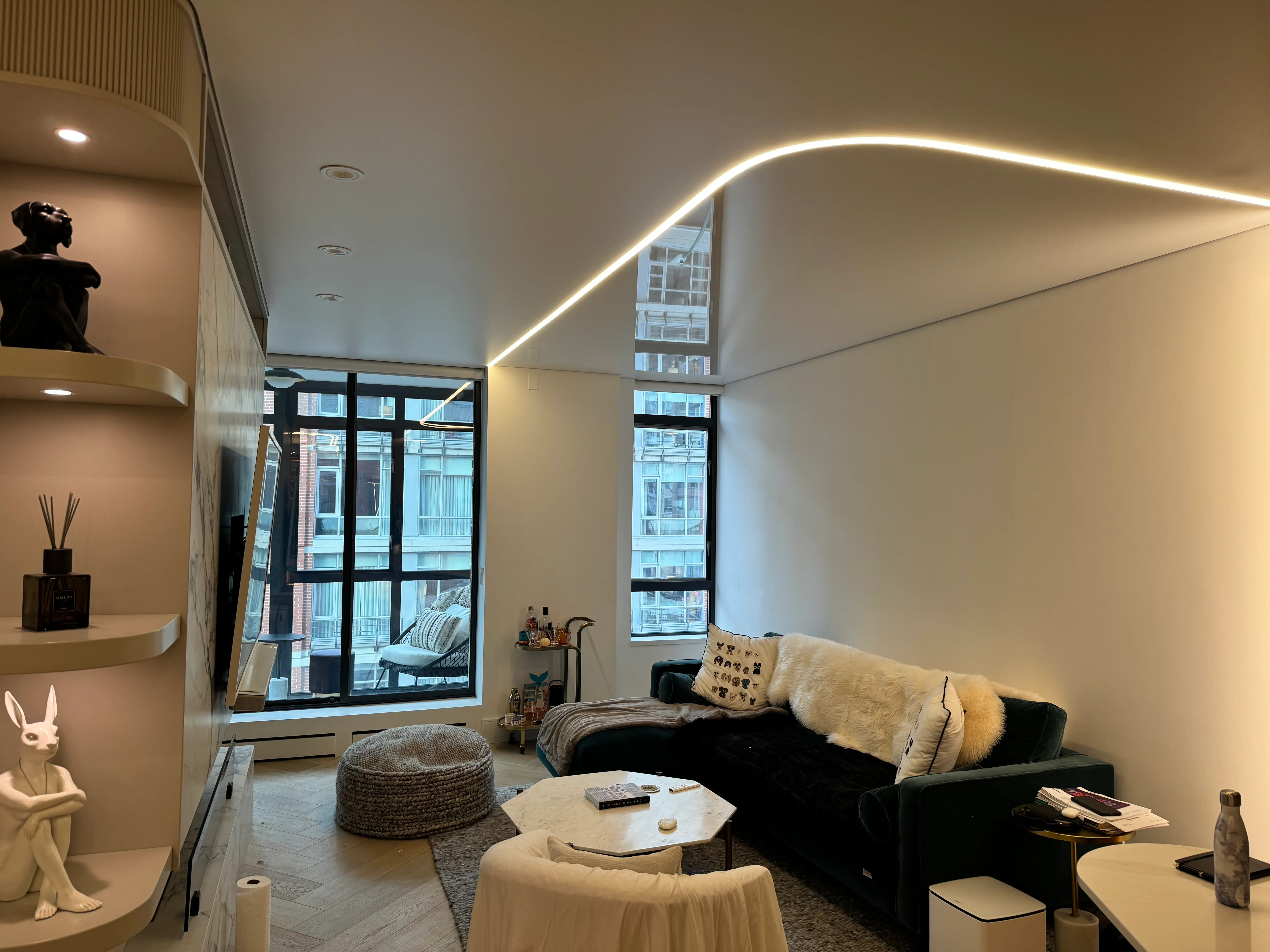
A stretch ceiling is a membrane held in a perimeter track fixed around the room. It is installed below the existing ceiling, so it hides what is above it and gives a flat, seamless plane without plastering, sanding or repainting.
That combination — a perfect surface, installed quickly, over a ceiling that may be far from perfect — is why the system is used so widely in both homes and commercial interiors.
How the system works
A track is fixed around the perimeter of the room, set at whatever height the design requires. The membrane is then tensioned into that track so it sits flat and taut. Lighting, speakers, sprinklers, vents and access points are accommodated with dedicated fittings built into the membrane before or during installation, which is why the lighting layout has to be settled before the ceiling goes in rather than after.
Because the finished plane sits below the original ceiling, the system absorbs an uneven, cracked or heavily serviced ceiling without those problems being made good first.
Finish options
Matte
Reads closest to a well-finished painted ceiling. The quiet choice for bedrooms, living rooms and offices where the ceiling should not draw attention.
Satin
A soft, low sheen that lifts light gently without turning the ceiling into a mirror. A middle ground that suits many residential rooms.
Gloss
Reflective. It visually raises a low ceiling and doubles the sense of space and light, which is why it appears in compact condominium rooms and in hospitality interiors. It is also the least forgiving choice: reflections show whatever is below, so the room beneath has to be worth reflecting.
Backlit
A translucent membrane lit evenly from behind, so the ceiling itself becomes the light source. The cavity depth, the light source and the spacing all determine whether the result is a soft even glow or a ceiling with visible hot spots — this is a design decision made before installation, not a product you simply choose.
Printed
An image printed onto the membrane. Used for feature ceilings in retail, hospitality and children's rooms. The strength of the result depends on the resolution and suitability of the artwork supplied.
Fibre-optic star ceilings
Fine fibres set into the membrane and driven by a concealed light source to create points of light. Common in home theatres, bedrooms, spas and hospitality spaces. Fabrication is largely done before the ceiling reaches site.
Integrated lighting
Stretch ceilings are frequently the reason a lighting idea becomes possible: recessed linear runs, perimeter cove details, floating light lines and backlit panels all sit naturally within the system. Fittings are positioned and reinforced within the membrane, so their locations must be fixed before installation. Final electrical connections are completed or coordinated by licensed electrical professionals.
Residential applications
In homes, the system is most often used where the existing ceiling is poor, where a room needs light without a cluttered array of fittings, or where a seamless plane is wanted above an open living level. It is also useful in condominiums, where opening up a ceiling can be disruptive and slow.
Commercial applications
In retail, hospitality, offices and multi-residential projects, the appeal is usually speed, a clean plane over heavily serviced ceilings, and the ability to build a lighting feature into the ceiling itself. Access panels can be planned where equipment above will need servicing.
Existing ceilings and preparation
Preparation is generally lighter than for a plastered ceiling, but it is not nothing. The perimeter has to be sound enough to take the track. Anything above that will be inaccessible afterwards — wiring, fixings, insulation, mounting for heavy fittings — has to be completed and, ideally, tested first. Loose material above the membrane should be dealt with rather than left.
Access to services above the ceiling
This is the question most often skipped and most often regretted. Once the membrane is in, the space above it is closed. Where sprinklers, valves, dampers, junction boxes or equipment will need future access, plan access points into the design from the outset. A membrane can be released and re-tensioned by an installer, but that is a service visit, not a homeowner task.
Installation sequence
Typically: confirm the lighting and services layout; complete work above the ceiling; set the perimeter track; install fittings and reinforcements; tension the membrane; connect and commission lighting through a licensed professional; then trim and detail the perimeter. Installation of a single room is usually measured in a day or two rather than weeks, which is a large part of the system's appeal in occupied spaces.
Maintenance and damage
Routine care is minimal — dust removal, and an occasional wipe with a soft cloth and mild cleaner for gloss surfaces, which show marks more readily. Avoid abrasive pads and sharp objects; the membrane is durable in normal use but it is not puncture-proof.
Whether a damaged membrane can be repaired or should be replaced depends on the location, extent and type of damage, as well as the visual requirements of the installation. The condition should be assessed individually.
Realistic benefits and limitations
The benefits are a flat seamless plane, fast installation, minimal dust, and lighting possibilities that are difficult to achieve otherwise. The limitations are equally real: the ceiling height drops slightly to accommodate the track; the space above becomes inaccessible unless planned for; the membrane can be punctured; gloss reflects the room honestly, including anything untidy; and a backlit ceiling only looks effortless if the cavity and light source were designed properly.
What influences cost
We do not publish prices, because a stretch ceiling is priced by the specifics rather than by the square metre alone. The factors that genuinely move a quote are room size and shape, the number of corners and level changes, the finish selected, whether the ceiling is backlit or printed, the number and type of integrated fittings, the amount of work required above the ceiling before installation, access and floor level, and whether the space is occupied or on a fixed fit-out window. A short site visit answers this far better than a calculator.
Frequently asked questions
How much ceiling height is lost?
Enough to accommodate the track and any lighting cavity. Where the ceiling is backlit or houses recessed fittings, more depth is required. This is confirmed on site against the specific detail.
Can it be installed in an occupied home or business?
Usually yes. It is one of the reasons the system is chosen — it is comparatively fast and low in dust compared with plastering.
What happens if it is damaged?
Whether a damaged membrane can be repaired or should be replaced depends on the location, extent and type of damage, as well as the visual requirements of the installation. The condition should be assessed individually.
Can lighting be changed later?
Fittings can be serviced through their apertures. Adding fittings in new positions means opening the membrane, which is installer work.
Is it suitable for bathrooms and kitchens?
Yes — it is unaffected by steam in the way a painted ceiling is, provided the room is ventilated properly.
Related pages
See Stretch Ceilings, Backlit Stretch Ceilings, Star Ceilings and Custom Lighting, or browse Ceilings & Lighting projects.
For a ceiling in a specific room, request a consultation and tell us the room, the ceiling height and what is above it.
Planning work like this?
Send us the space, the substrate and the finish you have in mind. We will tell you what is realistic before anything is ordered or installed.